I am publishing some important articles relating to demonetization.
https://byjus.com/commerce/what-is-demonetisation/
Demonetisation
Demonetisation is referred to as the process of stripping a currency unit of its status to be used as a legal tender. In simple words, demonetisation is the process by which the demonetised notes cease to be accepted as legal currency for any kind of transaction.
After demonetisation is done, the old currency is replaced by a new currency, which may be of the same denomination or may be of a higher denomination.
The impact of changing the legal tender status of a currency unit has a huge impact on the economic transactions that take place in an economy.
Demonetisation can cause unrest in an economy or it can help in stabilizing the economy from existing problems. Demonetisation is usually taken by a country for various reasons.
Demonetisation in India
Demonetisation in India has taken place three times till now, namely in the years of 1946, 1978 and 2016. Let us have a look at all the three events.
Demonetisation 1946
The first demonetisation event happened in 1946, at that time the denominations of Rs.1000 and Rs.10000 were removed from circulation.
There was a visibly low impact of the demonetisation as the higher denomination currencies were not available to the common people.
In 1954, these notes were again introduced with an additional denomination of 5000.
Demonetisation in 1978
The second demonetisation in India took place in 1978, at that time the Prime Minister was Morarji Desai. During the second demonetisation the denominations of 1000, 5000 and 10000 were taken out of circulation.
The whole purpose of demonetisation was to reduce the circulation of black money in the country. The announcement was made by Morarji Desai over the radio.
Demonetisation in 2016
The latest demonetisation was announced on 8th of November, 2016 by the Prime Minister Narendra Modi.
During this demonetisation the notes that were taken out of circulation were the denominations of 500 and 1000.
PM Modi also introduced new currency of denominations 500 and 2000 after demonetisation.
Objectives of Demonetisation
The objectives of demonetisation are as follows:
- To stop the circulation of black money in the market.
- To help in reducing the interest rates of the prevalent banking system
- To help in creation of cashless economy
- To formalise the informal Indian Economy.
- To remove counterfeit notes from the market.
- To help reduce anti-social activities and their finances.
This concludes the concept of demonetisation which helps in stabilising the economy and curb the spread of black money in the market. To read about more such interesting concepts on Economics for Commerce, stay tuned to BYJU’S.
- 5 reasons why demonetization affects interest ratesOn 8th November, the government made a shock announcement—500 and 1,000-rupee notes would be demonetized to curb black money, counterfeiting and fight terrorism.The move resulted in about 85% of the total value of currency being taken off from circulation.It is also likely to have short and long-term effects on the economy. One reason for this is the impact on interest rates.Here are five reasons why demonetization affects interest rates.
- High deposits in the banking systemBanks have witnessed a gigantic increase in deposits. This is mainly because of the short deadline for depositing high-value currency notes. Around Rs 5.5 lakh crore has already been deposited in banks till November 18, as per government data. This resulted in high liquidity in banks. In comparison, currency worth Rs 1.03lac crores has been issued till November 18.(source : https://www.rbi.org.in/Scripts/BS_PressReleaseDisplay.aspx?prid=38643) Since it could take a few weeks or possibly even months before the new currency gets into active circulation, banks will be flush with cash.
- Deposit rates slashedWith an abundant increase in deposits, deposit rates get slashed. This shouldn’t come as a big surprise to customers—it’s simple demand-supply economics. As the supply (deposits) increase, prices (deposit rate) fall. And that’s what has happened. Most banks have announced a cut. ICICI Bank and HDFC Bank cut deposit rates by as much as 0.25%. This cut is likely to continue too. “All rates will fall,” said SBI Chairman, Arundhati Bhattacharya in a recent report, indicating that deposit rates, as well as lending rates, could decrease further.
- Attractive borrowing ratesYes, the demonetization caused deposit rates to dip, but there is still some good news for customers. An excessive influx of deposits coupled with a poor demand for credit will force lending rates to decrease too. While this may not happen immediately, it can come in handy for prospective buyers looking for cheap loans in the near future.
- Disinflationary cash crunchThe demonetization has led to a cash crunch in the system. People have limited access to 100-rupee notes. Even those who did receive 2,000-rupee notes are unwilling to spend it because of issues with getting loose change. This means, demand for goods and services is likely to fall in the short-term. This is potentially disinflationary. After all, as demand falls, prices fall too. This could give the RBI room to cut key lending rates in the near future.
- Neutral effect in the long runLower demand because of the demonetization could exert a downward pressure on inflation in the near term. Similarly, categories such as food, housing and transport that have a higher cash component could witness a dip in prices. However, the government’s tax revenue is likely to increase. This could translate into higher investments and expenditure by the government. This could push up employment and incomes, and thus demand, in the long run. Hence, the impact on inflation—and thus interest rates—is expected to be neutral in the medium to long run, according to a CRISIL report.

 Rs 3 lakh croreThe Indian government scrapped 500 and 1000-rupee notes worth Rs 14 lakh crore, as per a Forbes report. Of this amount, roughly Rs 3 lakh crore is not likely to be exchanged for new notes, the Forbes report added. This amount is likely to be booked as profit by the RBI and transferred to the central government as dividend. Meaning, this could be additional income for the government.
https://corporatefinanceinstitute.com/resources/knowledge/finance/demonetization/
What is Demonetization?
Demonetization is an economic process in which a country’s currency unit is no longer legal tender. A currency unit is what we would commonly refer to as physical money, such as banknotes and coins. When demonetization occurs, the country’s currency unit is essentially worthless, as it can no longer be used to purchase goods and services.

Demonetization can occur for several reasons, from a change in national currency to the retirement of older forms of money. Over time, several countries have implemented currency demonetization measures, albeit with varying degrees of success.
Summary
- Demonetization is an economic process in which a country’s currency unit is no longer legal tender.
- After a currency has been discontinued, it is no longer legal tender and contains no monetary value.
- At times, countries may also decide to reinstate discontinued currency as legal tender through a process known as remonetization.
The Demonetization Process
Demonetization is a form of economic intervention, where a country moves to replace one form of currency with another. At the beginning of the demonetization process, the old currency is discontinued and pulled from circulation to be replaced with new forms of money.
During the process, people are given time to exchange their existing banknotes and coins for the new currency before it is officially discontinued. After a currency has been discontinued, it is no longer legal tender and contains no monetary value.
The demonetization process can occur in many different forms – a country can introduce new banknotes or coins or implement a completely new form of currency altogether. However, demonetization is a drastic measure that occurs rarely and can disrupt society if implemented improperly. At times, countries may also decide to reinstate discontinued currency as legal tender through a process known as remonetization.
Reasons for Demonetization
Although demonetization is rare, countries around the world have conducted demonetization measures for various reasons.
- Governments may choose to undergo demonetization if the currency gets out of control, due to problems like hyperinflation.
- Demonetization can also be used to prevent criminal actions, such as counterfeiting, terrorism, or tax evasion.
- In other cases, demonetization occurs to implement a new currency standard. For example, in 2002, the European Union introduced the euro, a central currency that would replace the existing currencies of several nations. In adopting the common currency, countries across Europe discontinued their currencies and introduced the euro as the standard across the European Union.
Advantages of Demonetization
Through the demonetization of currency, a country can receive benefits ranging from crime prevention to greater currency standardization.
1. Reduces various criminal activities
One of the benefits of demonetization is the reduction of various forms of criminal activity. Through the demonetization process, old banknotes and coins are discontinued and taken out of circulation, and effectively become worthless. For groups conducting criminal activities, such as terrorism, their supply of money effectively becomes worthless, as the currency is no longer legal tender.
For those engaged in counterfeiting, the banks will evaluate whether old banknotes are counterfeit before exchanging them, therefore allowing the government to remove counterfeit currency from the system.
2. Prevents tax evasion
Demonetization of currency can also prevent tax evasion, as those that are evading taxes must exchange their existing currency or risk their money becoming worthless. In the currency exchange process, the government can catch those who have evaded taxes and retroactive tax their unreported earnings.
3. Promotes a cashless economy
Demonetization can also further the push towards a cashless economy, as the government can slow the circulation of physical currency and move towards more digital options.
Disadvantages of Demonetization
On the other hand, some disadvantages can arise from the demonetization process, including:
1. Incurs costs from printing new banknotes and minting of coins
One of the initial drawbacks is the costs involved with the printing of new banknotes and the minting of coins, as well as the discontinuation of existing currency.
2. May not entirely reduce criminal activity
In addition, demonetization may not reduce criminal activity, as criminals may keep their assets in other forms, such as gold or real estate.
3. Can trigger chaos among citizens
Finally, if the demonetization process isn’t implemented successfully, it can result in chaos among the population, as people scramble to exchange their currency before discontinuation.
Real-World Examples
1. India (2016)
A recent example of demonetization was India in 2016 when the government announced the discontinuation of all ₹500 and ₹1,000 banknotes. It was done to reduce the presence of counterfeit cash to fund criminal activity.
When the demonetization was announced, there were shortages of cash across the country, as people scrambled to exchange their existing banknotes. It led to disruptions to the economy, reducing India’s industrial production and hindering its GDP growth rate.
2. Eurozone (2002)
Another example of demonetization was the European transition to the euro in 2002. To facilitate the process, the European Central Bank needed to ensure that there was enough currency to be circulated and began printing banknotes and minting coins as early as 1998.
When the euro was introduced, the central bank ensured that all citizens were able to access to the new currency and began providing banks with the new banknotes and coins several months in advance.
Related Readings
CFI is the official provider of the Commercial Banking & Credit Analyst (CBCA)™ certification program, designed to transform anyone into a world-class financial analyst.
To keep learning and developing your knowledge of financial analysis, we highly recommend the additional resources below:
India’s demonetized currency finds its way back into the system — but can we still call it a success?
PUBLISHED FRI, SEP 1 20175:13 AM EDTUPDATED FRI, SEP 1 20179:59 AM EDTKaren GilchristSHAREShare Article via FacebookShare Article via TwitterShare Article via LinkedInShare Article via EmailKEY POINTS
- India’s demonetization policy failed to purge black money from the market, but analysts still view it as a success.
- Prime Minister Narendra Modi’s BJP party saw a resounding electoral win in March, following implementation.
- The program has improved tax returns and encourage digital payments, figures suggest.

Adnan Abidi | Reuters
India’s demonetized currency may have found its way back into the system but analysts suggest that far from tarnishing Prime Minister Narendra Modi’s image, the strategy will ultimately be viewed as a success.
“It’s important to remember that the demonetization move was intended more as a political move than as an economic one,” noted New York-based South Asia-focused Eurasia Group analyst Sasha Riser-Kositsky.
“The drama of demonetization allowed Prime Minister Narendra Modi to demonstrate in a very visible way his commitment to fighting corruption and black money.”ADVERTISING
Earlier this week, the annual report from the Reserve Bank of India (RBI), the country’s central bank, found that a total of 15.28 trillion rupees ($239 billion) worth of cancelled high-value notes were deposited or exchanged for new money in the 10 months since the strategy was implemented – just one percent shy of the number in circulation before the plans came in.
The results suggest a damning failure for Modi and his flagship policy. In November last year, Modi announced the radical step to demonetize the currency notes in order to tackle the rampant problem of the so-called black money – billions of dollars’ worth of cash in unaccounted wealth and fake currency notes. The government decided to introduce a new 500 rupee note and also introduce a higher denomination banknote of 2,000 rupees.
Opponents hit out at Modi and accused him of damaging the economy and tarnishing the country’s credibility at home and abroad. First quarter gross domestic product (GDP) data released Thursday marked a three-year-low of 5.7 percent, versus 7.9 percent the year before. The RBI had to spend 79.65 billion rupees on quickly printing updated replacements for the 500 rupee ($7) and 1,000 rupee notes which were abruptly banned at midnight on November 8 last year, according to the central bank’s annual report.WATCH NOWVIDEO04:08How to build a cashless society? Give people no other choice
Meanwhile cash-dependent small businesses and poorer citizens – those Modi had claimed to be helping – have been badly hurt by note-shortages this year.
Prior to the data release, it was unclear how successful Modi’s policy had been, and as such his political motives were enough to win him favor with India’s vast segment of poorer voters at the polls. His Bharatiya Janata Party (BJP) won overwhelming support in March elections in Uttar Pradesh, India most populous and one of its poorest states.
“The government and its supporters can argue that even if demonetization failed to remove black money from circulation, that at least Modi and the government tried to do something about it,” Riser-Kositsky told CNBC via email.
But politics aside, analysts claim that the economic benefits will emerge over time.
“The demonetisation campaign clearly contributed to economic slowdown, reflected in poor GDP figures in April-June. In hindsight, this can be deemed a failure from an economic point of view,” Firat Unlu, leading India analyst at the Economist Intelligence Unit, told CNBC.
“Still, assuming that demonetisation is complemented by efforts to enhance tax compliance, then some success can be salvaged and lead to higher government revenue.”

An Indian bank employee counts old 500 and 1000 rupee notes in Guwahati, the capital city of the north-eastern state of Assam on December 30, 2016.Biju Boro | AFP | Getty Images
As a result of demonetization, and in tandem with Modi’s ‘Digital India’ strategy, which aims to expand India’s online infrastructure, the country now sits on a treasure trove of data. The government has been gradually making enrolment to its national electronic database ‘Aadhaar’ mandatory for tax returns, opening of bank accounts and any purchases above 50,000 rupees. It is estimated that over 99 percent of Indians aged 18 and above are now enrolled in the scheme.
This means that the government can expect to see the benefits of taxation on previously hidden black money over the coming months and years.
India’s finance ministry says it is probing 1.8 million bank accounts where cash inflows during the demonetization period “did not appear in line with its tax profile,” meaning it can expect some belated tax payments.
“There are also long-term benefits from demonetization in terms of increasing income tax payments going forward and encouraging the use of digital payments over cash, a means of encouraging better tax compliance among businesses,” Riser-Kositsky explained.
However, whether it is a model to be replicated by other countries struggling to combat corruption and illicit money is not yet clear.
For Unlu, the initial economic fallout may be too much for other economies to stomach. “On balance, governments abroad are unlikely to replicate India’s experiment given the economic fallout,” he said. Traditionally, other governments have only embarked on demonetization schemes in times of extreme need, such as hyperinflation, political upheaval and wars.
One Year Later: India’s Demonetization Move Proves Too Costly An Experiment
Suparna Dutt D’CunhaContributorAsiaI cover startups & enterprises in India and the UAE.FollowThis article is more than 4 years old.
TWEET THIS
- The hands-down winners are the mobile wallet players, particularly Alibaba-backed Paytm, which now has 250 million registered users.
- All in all, demonetization accomplished too little while causing too much collateral damage.
![Indians queue near an ATM counter at an Indian bank to withdraw money in Bangalore on November 21,... [+] 2016. (Photo credit AFP/Getty Images).](https://thumbor.forbes.com/thumbor/960x0/https%3A%2F%2Fspecials-images.forbesimg.com%2Fimageserve%2F624810820%2F960x0.jpg%3Ffit%3Dscale)
Indians queue near an ATM counter at an Indian bank to withdraw money in Bangalore on November 21,… [+]
Last year on November 8, Indian Prime Minister Narendra Modi declared that all 500 and 1,000 rupee notes would cease to be legal tender in a surprise television announcement. Demonetization, as it was called, applied to 86% of the value of all currency in circulation.
The goal, Modi said, was to eliminate fake Indian currency notes, curb terrorism, and force out stashed cash people had hidden to avoid paying taxes. Later, when criticism erupted, the government said demonetization would also help India switch from cash to digital money.
Read more on Forbes: A Cashless Future Is The Real Goal Of India’s Demonetization Move
PROMOTEDhttps://6b911b2fc5a263372d31d338cc51f19d.safeframe.googlesyndication.com/safeframe/1-0-38/html/container.htmlhttps://6b911b2fc5a263372d31d338cc51f19d.safeframe.googlesyndication.com/safeframe/1-0-38/html/container.htmlhttps://6b911b2fc5a263372d31d338cc51f19d.safeframe.googlesyndication.com/safeframe/1-0-38/html/container.html
One year later, with data now available, it’s time to assess what demonetization has actually wrought — the good and the bad.https://imasdk.googleapis.com/js/core/bridge3.490.0_en.html#goog_415192209India’s Currency CrackdownWATCH1:13
Some good
The good news starts with the widening of the tax base. The number of income tax returns filed for 2016-17 year grew by 25%, which is crucial to ease pressure on public finances in a country that has well over 1.25 billion people but less than 30 million file tax returns.
However, there have been conflicting claims on the tax surge. In May, Finance Minister Arun Jaitley said 9.1 million new taxpayers were added, but in August, Prime Minister Modi said there was an increase of 5.7 million taxpayers after demonetization. Meanwhile, the Economic Survey put the number of new taxpayers at 5.4 million, or just 1% of all individual taxpayers.
![Demonetization has given digital wallets like Paytm, MobiKwik and Freecharge an extra push. (Photo... [+] credit Bloomberg).](https://thumbor.forbes.com/thumbor/960x0/https%3A%2F%2Fspecials-images.forbesimg.com%2Fimageserve%2F39707539%2F960x0.jpg%3Ffit%3Dscale)
Demonetization has given digital wallets like Paytm, MobiKwik and Freecharge an extra push. (Photo… [+]
Digital transactions have surged, too. More efficient than paper money, digital money is expected to bring in transparency into the system. The hands-down winners are the mobile wallet players, particularly Alibaba-backed Paytm, which now has 250 million registered users. That’s a 105% increase from January 2016.
Read more on Forbes: India’s Youngest Billionaire, Is Cashing In On Country’s Move Away From Paper Currency
Innovation emerged as well, such as the government-backed payment app BHIM, which facilitates easy electronic transfers between bank accounts. But digital payments haven’t substituted the use of paper money as India still remains a cash economy.
So do these few improvements set off the hardship and job losses among the most vulnerable?
More bad
Demonetization wrecked the primarily cash-reliant rural economy, adding distress to mounting debts. The agricultural sector, which is behind in reforms and investment, worsened due to cash shortages, plunging demand and collapsing prices. Prices of potatoes, onions and tomatoes were half of what they had been a year before in January-February. The outcome was widespread suffering and farmer unrest in the states of Madhya Pradesh, Maharashtra, Gujarat, Tamil Nadu and Rajasthan.
The downturn spilled over to other sectors. A survey by India Development Foundation found that production took a hit, accompanied by fall in employment, wages and job losses in the two months after demonetization. In Mumbai, more than 50% of the power loom units were shut down, impacting around 300,000 workers. Around 1.5 million jobs were lost in the first four months of this year.
Read more on Forbes: How India Is Surviving Post-Demonetization
Surveys done by the Punjab Haryana Delhi Chamber of Commerce and Industry, All India Manufactures Association and State Bank of India showed that the impact was between 50% and 80% on small and unorganized sectors. The Reserve Bank of India’s Annual Report (RBI) stated that industry slowed down.
![An Indian farmer waits for the customers to sell his harvest at a wholesale market on the outskirts... [+] of Jammu, India. Farmers were among those who bore the maximum brunt of demonetizaion. (AP Photo/Channi Anand)](https://thumbor.forbes.com/thumbor/960x0/https%3A%2F%2Fspecials-images.forbesimg.com%2Fimageserve%2F29dc53630f734a63b7313bf3ae4a7ce1%2F960x0.jpg%3Ffit%3Dscale)
An Indian farmer waits for the customers to sell his harvest at a wholesale market on the outskirts… [+]
The economy is also still coping with aftermath. In the first quarter of fiscal 2017-18, growth slumped to 5.7% compared to 7.1% in the same quarter of the previous year.
Although there is no way to be absolutely certain that the cause of all this is demonetization, there are some telltale signs: Rural loans increased by only 2.5% between October 2016 and April 2017; the growth in industrial output in April was 3.1%; and the construction sector registered negative gross value added growth.
Too high a cost?
On top of this, little black money has been brought to light. Of the $240 billion USD worth of the notes removed from circulation, the government estimated that as much as a third wouldn’t be deposited in banks, implying that black marketeers would junk their undeclared cash than risk being found out. But this didn’t happen. According to RBI’s report, banks received around $220 billion USD, or 99% of the money.
Even as RBI stated that there has been a significant increase in the rate of fake currency note detection, the government’s freshly minted 2,000-rupee notes, issued after demonetization, are already being counterfeited. If this was not enough, the RBI suffered a loss printing new currency notes — the cost of printing notes was nearly $900 million in 2016-17, which is double the $450 million spent a year prior.
All in all, demonetization accomplished too little while causing too much collateral damage. But despite the economic toll, Modi has solidified his power base.
What Happens When A Country Suddenly Gets Rid Of Most Of Its Cash?
- SUBSCRIBE
September 24, 20196:30 AM ET

Hindustan Times/Hindustan Times via Getty Images
Editor’s note: This is an excerpt of Planet Money’s newsletter. You can sign up here.
On Nov. 8, 2016, Narendra Modi, the prime minister of India, stepped in front of TV cameras and announced that the nation would almost immediately begin getting rid of most of its cash. Indians would have to exchange or deposit their large rupee bills in a matter of weeks — or else the bills would become worthless. Poof. Gone. The policy was supposed to end corruption, counterfeiting and a large shadow economy; it was also a push to turn India’s backward, cash-dependent economy into a modern, electronic one.
But what followed proved to be chaos.
The surprise announcement sent millions and millions of Indians scrambling to exchange their cash. They left their jobs and waited in long lines at the bank. They upended their lives trying to preserve their savings. Businesses, starved of payments, crumbled. The whole story is nuts, and Planet Money has two great episodes that tell it. You can listen to them here and here.
It has now been a few years since India’s “demonetization,” as Modi called it. And the data are coming in. A new study, forthcoming in the prestigious Quarterly Journal of Economics, gives us a one-of-a-kind look at what this radical policy meant for the economy.
What happens when you suddenly get rid of cash?
Gabriel Chodorow-Reich is an economist at Harvard University, and he and his colleagues quickly saw demonetization as a perfect “natural experiment,” a rare opportunity to look at how economic theory plays out in the real world.
You might think that Chodorow-Reich and his team could have just looked at official statistics, like gross domestic product, to get the story. But GDP misses a lot, especially in a country like India, where there is a massive underground economy. To get around this problem, Chodorow-Reich and his colleagues used other measures, like satellite imagery of lights at night. When people spend money, restaurants, factories, bars and cars light up the night sky. The idea is more light, more economic activity. Economists have increasingly been using changes in night luminosity, as seen from space, as a way to measure economic growth in places where official statistics are spotty.
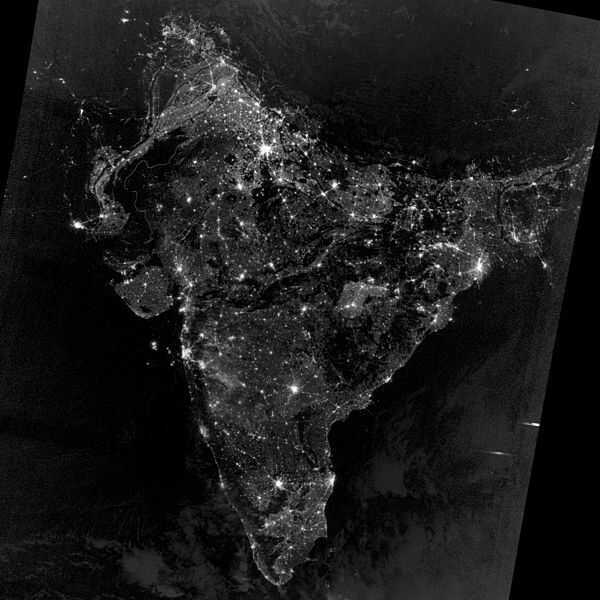
India at night, as seen from space.Wikimedia Commons
The Indian government wiped out 500- and 1,000-rupee notes, representing 87% of the total cash in circulation. It then shipped in new types of bills, which are harder to counterfeit, to the roughly 600 districts in the country. The new bills were sent to districts at different speeds and in different batches, and Chodorow-Reich says that this wasn’t done with much recognition of where the old notes came from. As a result, some districts became much more starved for cash than others, and the economists used data on these cash shortfalls to measure the effect of cash on economic growth.
Chodorow-Reich and his team found that the policy of rapid demonetization caused a 2 percentage point crash in economic growth during the first few months after the policy was announced. To put that in perspective, the Indian economy was growing at just over 2% per quarter during this period. So essentially, the policy halted economic growth. The decline could be seen by satellites at night; the country looked dimmer.
Lessons for the cashless movement
There’s currently a movement to get rid of cash. One of its leaders is Chodorow-Reich’s colleague at Harvard, Kenneth Rogoff. Rogoff wrote a book called The Curse of Cash, and he makes the case that eliminating large bills will have all sorts of societal benefits, starting with a reduction in crime and corruption.
Chodorow-Reich’s study raises the prospect that the movement to get rid of cash has a real cost. But he cautions that such a policy might work out differently in a country like the United States. India has a massive population of people without bank accounts, credit cards or payment apps — and the United States is much more advanced in this regard. It’s not as dependent on cash.
India surely suffered under this policy, but Chodorow-Reich and his team do find that it helped promote the adoption of electronic forms of payment. Moreover, once new cash replaced the old notes and people adjusted to the new payment systems, things returned to normal. “If India had been able to print those notes and distribute them instantaneously, there wouldn’t have been any problem,” Chodorow-Reich says.
Which is why Chodorow-Reich advises that if a country wants to get rid of cash, it should heed this key lesson from India: “You don’t want to do it suddenly,” he says. “There are adjustment costs.”
What happened after India eliminated cash
https://www.strategy-business.com/article/What-Happened-after-India-Eliminated-Cash
Two years ago, the Indian government abruptly wiped out most of the nation’s currency in hopes of ending black money and curbing corruption. Has the experiment worked?
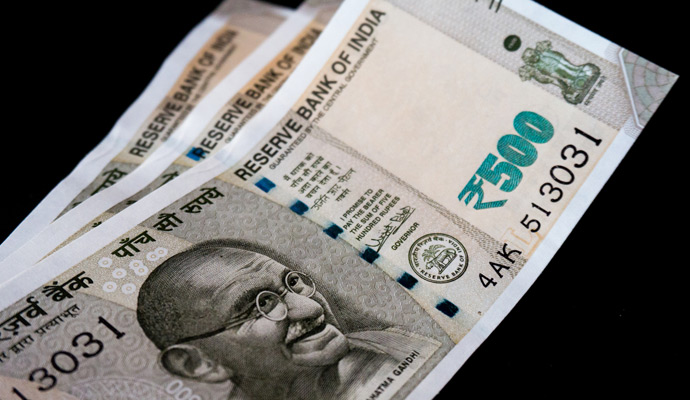
Illustration by amlanmathur
On the night of Nov. 8, 2016, there was a surprise announcement on Indian television. In a live telecast to the nation, Prime Minister Narendra Modi declared that the country’s two highest-denomination currency notes (Rs 1,000 and Rs 500) would be withdrawn immediately from the market. The plan, termed demonetization by the press, was planned in secrecy and announced dramatically, as Modi’s masterstroke against black money.
As economic experiments go, it was a big, bold move. There was no precedent, anywhere in the world, for a sudden economic shock of this scale. The withdrawn notes, amounting to US$320 billion at the time, represented 86 percent of the total currency value in circulation in India. By making the notes worthless almost overnight, the government hoped to destroy large piles of black money hidden away by tax evaders. In addition, the government claimed the plan would strike a major blow against corruption and counterfeiting and would kick-start India’s transition into a digital, cashless world. In a country with a huge informal economy, dependent on cash transactions, demonetization was a big political gamble, too.
Related Stories
- Be prepared for disruption: Thinking the new unthinkablesby Nik Gowing and Chris Langdon
- The new ways to win in emerging marketsby David Wijeratne, Gagan Oberoi, and Shashank Tripathi
- Social Entrepreneurship by the Billionsby Roger L. Martin, Sally R. Osberg, and Jennifer Riel
The immediate fallout was chaos, as the country scrambled to cope. There was a rush at banks and ATMs to exchange old notes and withdraw new currency. Queues at banks grew; many people suffered, especially the poor, who had no access to credit cards or mobile wallets; and dozens of deaths resulting from the crisis were reported.
Two years later, the dust has settled, and it has become obvious that demonetization was not the resounding success the government expected it to be. India’s black money problem has not gone away. The economy has taken a beating, huge financial losses have been incurred, and the marginalized poor, least able to withstand adversity, have been negatively affected. There have been some gains in tax collections, and the country has progressed toward digital payments, but these advances could have been achieved through other, less drastic means.
For countries tackling black money or promoting a cashless economy, India’s experience with demonetization provides rich lessons. Although the long-term social, economic, and political consequences of demonetization are still playing out in India, answers to many complex questions are now apparent.
What Happened to the Black Money?
Economists who supported demonetization predicted that black money hoarders would destroy their stashes rather than declare them, thus delivering a bottom-line bonanza to the country. But in August 2018, the Reserve Bank of India (RBI), the country’s central bank, confirmed that 99.3 percent of the demonetized notes had been returned to the banks. Almost nothing was extinguished.
It has become obvious that demonetization was not the resounding success the government expected it to be.
Clearly, assumptions proved to be far from reality. Unlike portrayals in Bollywood films, it appeared that big tax evaders had not stashed away bundles of cash, but more likely held their money in real estate, gold, and Swiss bank accounts. Whatever was held in cash found its way back into the banking system. The press reported that the wealthy sold their currency at discounted rates to money-laundering intermediaries, who then deposited the notes into the banking system through the accounts of low-income Indians. Ultimately, the RBI did not receive any windfall. Instead, the cost of printing lower-denomination notes and managing the demonetization exercise put a sizeable dent in the central bank’s coffers, reducing its annual dividend to 46 percent of what it paid the government the previous year. There was very little counterfeit currency detected among the notes returned.
The withdrawal of Rs 1,000 and Rs 500 notes was meant to signal a tough stance against black money by making it difficult to hoard large sums of cash. However, the government immediately introduced a new Rs 2,000 note, which seemed to defeat the purpose of eliminating the other high-denomination notes. The government offered no explanation for the move. And counterfeits were detected in the newly printed currency within a month of demonetization, suggesting that the counterfeiting network quickly adapted.
What Happened to Economic Growth?
The abrupt withdrawal of cash from India’s economy, without adequate or timely replenishment, hurt the farming and industrial sectors. Demand for goods and services fell immediately after demonetization. Segments that relied on cash transactions — such as agriculture, organized and unorganized retail, and the micro, small, and medium enterprise (MSME) sector — suffered most. A November 2017 study of 3,000 regulated agricultural markets for 35 major agricultural commodities, conducted during the three months immediately following demonetization, concluded that eliminating the high-currency notes had reduced the value of domestic agricultural trade by more than 15 percent in the short run, settling at 7 percent reduction three months later. The implementation of a nationwide goods and services tax (GST) in July 2017 provided yet another major economic disruption.
The Centre for Monitoring Indian Economy (CMIE), a private forecaster, estimated that 1.5 million jobs were lost between January and April 2017. The labor force further shrank from 439.7 million in the fiscal year 2016–17 to 426.1 million in 2017–18. And the labor force participation rate (which expresses the labor force as a percentage of the working-age population) fell from 46.1 percent to 43.5 percent. According to CMIE, those ages 15 to 24 were the most affected, probably because they were relatively new to the workforce and typically held low-skilled, informal jobs paid by cash. GET THE STRATEGY+BUSINESS NEWSLETTER DELIVERED TO YOUR INBOX
(sample)Email
According to the RBI, India’s GDP growth rate slowed from 8 percent in 2015–16 to 7.1 percent in 2016–17, to 6.7 percent in 2017–18. And the Central Statistics Office of the Government reported that during the first quarter of the fiscal year 2018–19 (April to June 2018), India’s GDP registered growth of 8.2 percent, on the back of a good performance by the manufacturing and farming sectors. However, it might be premature to celebrate this as an indicator that the country is bouncing back to pre-demonetization levels. Tighter financial conditions, high oil prices, and slowing global growth are expected to slow GDP growth again in the second half of this fiscal year, which has led the RBI to forecast GDP growth at 7.4 percent for 2018–19. Although this is still high compared with world trends, the country’s economic performance would have been better without the dampening effects of demonetization.
Did Tax Collections Improve?
Excluding the effects of a tax amnesty plan launched months before demonetization, government data shows there was no major growth in tax collections in the 2016–17 financial year. In the next financial year, though, both the number of taxpayers and direct tax collections grew significantly, by 10 percent and 19 percent, respectively. Tax buoyancy (tax collection growth after factoring in GDP growth) also improved. The Finance Ministry announced in August 2018 that the tax department was scrutinizing 1.8 million accounts, totaling $40 billion. However, in a country notorious for large-scale corruption, it remains to be seen whether the scrutiny will yield concrete results.
Without complex economic and behavioral modeling, it’s difficult to isolate the effect of amnesty plans, demonetization, GST, and tax administration reforms on tax compliance and collections. But direct and indirect tax data for 2017–18 suggests that India is making progress on the path to a more formal, tax-compliant economy.
Did India Move Closer to a Cashless Economy?
The Indian economy traditionally has been dominated by cash. According to an April 2018 World Bank report (pdf), 190 million adult Indians do not have bank accounts. Even among those with bank accounts, many are still poor and illiterate, with no access to credit or debit cards or Internet banking.
In the months following demonetization, when cash became unavailable, there was a sharp rise in debit and credit card transactions. Those who did not have cards applied for them, but it was difficult to get new cards quickly. Mobile wallets, with simpler documentation and Know Your Customer (KYC) requirements, stepped in to bridge the gap. Paytm, an Indian startup, quickly became the market leader, allowing merchants to register even without a bank account.
Although initial enthusiasm for mobile wallets has tapered off, it sparked adoption of mobile payments, particularly for low-value transactions. Paytm announced in July 2018 that it had more than 100 million active users, with gross transactions totaling $50 billion in a year (with an average transaction value of $10). Several other big players have entered the market and reported strong growth. Multiple tailwinds — the increased penetration of affordable smartphones, the growth of e-commerce, improvements in telecom and payment infrastructure, and the availability of multilingual wallets — are pushing this growth in mobile wallets.
However, mobile wallets represent less than 5 percent of the total value of retail digital transactions in India. More than 85 percent of retail electronic transfers (in terms of value) are done using the National Electronic Funds Transfer (NEFT) platform, which enables individuals and businesses to transfer funds across bank accounts. NEFT showed growth of 44 percent in 2016–17 and 43 percent in 2017–18. This is in keeping with the increasing value of NEFT transactions over the last five years (with a CAGR of 42 percent from 2013 to 2018). So, it appears that although electronic NEFT payments continue to grow steadily in India, demonetization has not really accelerated the rate of growth.
India’s love affair with cash also remains strong. ATM withdrawals dropped in 2016–17, but picked up pace when currency was freely available again. A July 2018 PwC report (pdf) on ATMs in India shows that from April 2017 to March 2018, the average month-on-month growth in ATM transaction values was 1.16 percent, compared with 1.04 percent from May 2014 to October 2016 (pre-demonetization). According to the RBI, currency in circulation grew by 37 percent in 2017–18, and the currency-to-GDP ratio increased from 8.8 percent to 10.9 percent. The real estate sector, known for large cash transactions, experienced a major setback immediately after demonetization, but cash has now begun to make its appearance in property and land deals.
It is reasonable to conclude from the data that India is on a journey toward digital payments, with demonetization providing a positive nudge. But cash remains king; and many Indians remain outside the ambit of digital transactions.
What About the Common Person?
In the days after demonetization was announced, the press carried harrowing stories of human suffering. The shortage of cash resulted in medical and personal emergencies. Several tragedies were reported. The prime minister appeared on television, acknowledging the anguish, and called on the people to join him on a mahayagna, a grand sacrifice to rid India of corruption. It appeared that many Indians bought into the idea of a war on corruption. Even through many days of widespread distress, there were no major riots or violent incidents.
Several academicians and activists documented the impact of demonetization on the rural poor. A study of 492 households from 10 villages in the southern Indian state of Tamil Nadu reported that more than one-third of those surveyed had less work after demonetization. Agricultural wage workers and the self-employed suffered the greatest effects. Several people reported permanent loss of work, or loss of markets, as they were replaced by competitors who adapted better to being cashless. As cash disappeared, people relied more strongly on networks of friends and family to sustain their economic and social activities. Informal debt rose sharply. Those without such support networks suffered the most, particularly because state social protection is weak in India and governmental programs are notoriously subject to patronage.
A survey of 200 families living in 28 slum neighborhoods in Mumbai, conducted in December 2016 and February 2017, showed that 40 percent of households reported losing about 40 percent of their monthly income due to demonetization. Consumption and savings decreased, household debt increased, and the ability to repay debt worsened. Respondents reported an increased acceptance of cashless payment methods, but cash remained the preferred payment form. The attitude toward different forms of savings changed significantly, with respondents showing a decreased willingness to hold cash at home. In spite of income losses, at the beginning of February 2017, 51 percent of the sample surveyed felt positive about demonetization, feeling it was for the good of the country, while 22 percent had a negative opinion.
What Were the Political Implications?
Modi’s Bharatiya Janta Party (BJP) came to power in 2014 with a strong majority mandate, allowing him to take a political gamble with demonetization. If black money had indeed been extinguished in a significant way, it would have established Modi as a champion of the poor and consolidated his party’s hold on the electorate. Demonetization turned out to be a damp squib, though, and dented Modi’s image as a leader who could do no wrong. Nonetheless, the BJP won assembly elections in eight of the 12 states that went to the polls in 2017 and 2018. It seems that neither poor economic performance nor the combined shocks of demonetization and GST have halted BJP’s journey toward becoming India’s leading national party.
The Final Verdict
The Indian government issued a press statement in August 2018, claiming that demonetization was a success. The facts do not support the claim.
If the goal of demonetization was to reduce black money, a gradual and steady withdrawal of high-denomination notes would have perhaps served the purpose better. If the objective was to make the country more tax-compliant, then it would have been better to pursue administrative reforms in taxation and increased automation of processes, along with amnesty plans and customer education. Some argue that the Tax Department now has information about who has money, and thus demonetization can help find those guilty of tax evasion. But to make use of this information, the country needs corruption-free, effective tax administration (which was part of the original problem Modi sought to correct). The success of the nationwide GST in bringing more people under the tax net, and increasing both direct and indirect tax collections, is proof that there are better ways to bell the cat. India is now moving faster toward cashless transactions. However, the government had been making moves to digitize before demonetization. Aadhaar (a unique identification number for each Indian), Jan Dhan (universal banking), UPI (unified payments interface), and many other initiatives were already underway. It would have been better to push through those plans gradually, bearing in mind the needs of the weakest sections of society.
In a largely informal economy where the most vulnerable people still have no access to digital payments, demonetization was an ill-considered, draconian measure that did a lot of damage to the Indian economy. At the end of two years, the benefits do not seem to have been worth the enormous financial losses and suffering.
 Janamejayan's धर्म जिज्ञासा